 Roosta
Alarms for heavy sleepers
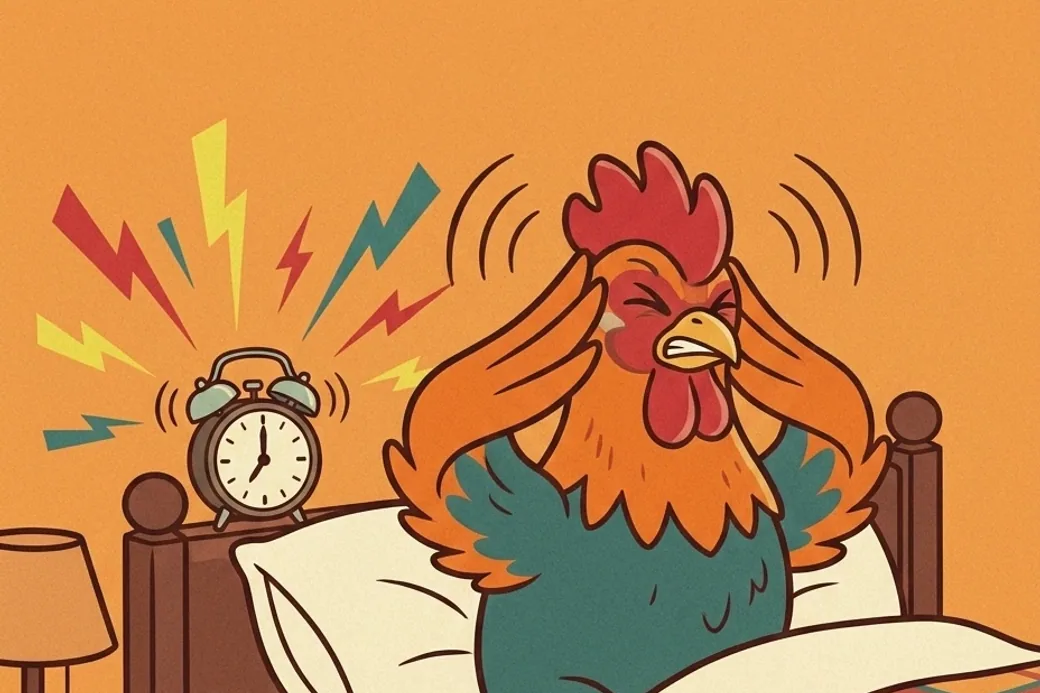
There is a category of person for whom ordinary advice about mornings is useless, because it all assumes the alarm woke you. If you are the one whose flatmates have heard the alarm and you have not, none of it applies. You need the tier below that: what to do when the sound itself is not landing.
Here is the honest version, roughly in the order worth trying.
Change the tone before you change anything else
Free, takes ten seconds, and it is the cause far more often than people expect. Your brain learns to filter out familiar sounds that have never once meant trouble, and after months of the same tone that is exactly what it has become. A sound with no history behind it gets through at a fraction of the volume.
Set a reminder to change it every month. If nothing else on this page appeals, do this one.
Vibration you cannot ignore
A bed shaker — a puck that goes under the mattress or the pillow and is driven by a bedside clock — is the standard recommendation for genuinely heavy sleepers and for deaf and hard-of-hearing people, and it works for a reason that has nothing to do with volume: it is a different sense. Filtering out a familiar sound is easy. Filtering out the bed moving is not.
It is the single most effective piece of hardware in this category and the least often tried, mostly because it costs money and looks medical.
Light, arriving before the sound
A sunrise alarm brightens over twenty or thirty minutes before it makes any noise. It does not wake you on its own — that is not the claim — it brings you up into the lighter part of your sleep so that the sound, when it comes, is landing on someone much easier to wake.
This is the one that turns a brutal morning into an ordinary one rather than fixing the alarm as such, and it is worth most in winter, when the light your body used to get for free is not there. See waking up early in the dark.
Distance, with a caveat
Putting the phone out of arm’s reach helps, and it helps immediately. The caveat is that it decays: after a few months the walk to the phone becomes part of the same reflex as reaching for it, and people who do this reliably report waking up back in bed with no memory of having crossed the room.
Treat distance as buying time rather than as a solution. It is worth doing and it is not the last thing you will need to do.
A rule that sorts this whole list: anything that can be completed by someone who is not awake will eventually be completed by someone who is not awake. Distance, extra alarms and higher volume all fail that test. Vibration and missions pass it.
What does not work, honestly
- Turning the volume up. If the sound is being filtered rather than missed, louder does not address it. If it is being dismissed rather than slept through, louder just gets dismissed faster.
- Stacking five alarms ten minutes apart. This teaches you that the first four do not mean anything, which is the opposite of the lesson you want. It also fragments the last hour of sleep into pieces too short to be any use — see why the snooze button makes you more tired.
- A second device. Same off switch, second thing to buy.
- Willing yourself. Deciding at eleven at night that tomorrow will be different is not a mechanism. It is a hope with a bedtime.
Mission alarms
The category where turning the alarm off requires finishing a task — a set of push-ups, a photograph, some arithmetic — rather than pressing a button. There are several apps that do this and they vary a lot in how seriously they mean it.
The thing to check before you pick one is whether the task can be skipped. A great many of them have a mission and, somewhere in the corner, a way past it — an emergency dismiss, a "I really have to go" button, a cancel. That escape hatch is the whole ballgame, because six-in-the-morning you will find it, use it, and not remember.
The second thing to check is whether the mission can be changed in the morning. If it can, the difficulty you chose last night is not the difficulty you will face.
Where Roosta sits
Roosta is a mission alarm with neither of those exits. No snooze, no skip, and no button that means "trust me" — the alarm stops when the mission you chose the night before is finished, and walking out of the mission starts it again. Inside the hours before your target the alarm and its settings freeze, so the mission you chose is the mission you get.
It is not a replacement for a bed shaker if you genuinely do not hear sound. Those two solve different halves — one gets the signal to you, the other stops you from ending it before you are awake — and if you are a very heavy sleeper the honest answer is that you may want both.
If what you actually have is an alarm you dismiss without remembering, that has its own article, and it is the more common case by a distance.