 Roosta
How to wake up early when you have already tried everything
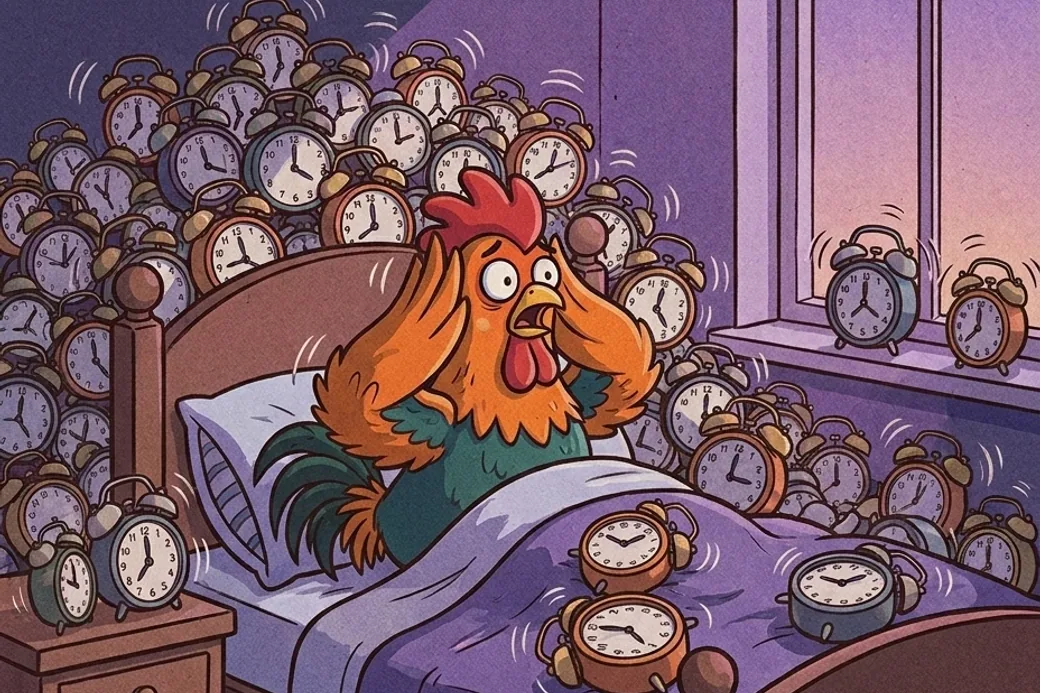
There is a version of this article that tells you to go to bed earlier and put your phone across the room. You have read it. You have probably done both. If you are here, the interesting question is not what to try — it is why the things you already tried stopped working.
Why willpower at six in the morning is the wrong tool
You are not one person across a night. The one who sets the alarm has goals, a calendar and a reason. The one who hears it has none of those loaded yet — half a second after a noise, in the dark, with sleep inertia at full strength, running on whatever is cheapest.
So when you plan to "just have more discipline tomorrow", you are making a promise on behalf of somebody who will not be there. It is not a character failure that it does not hold. It is a design failure: you put the decision at the exact moment you are least able to make it.
Everything below is an attempt to move the decision earlier, or to make the morning one not require a decision at all.
Fix the night, not the morning
Almost every failed early-rising attempt is a bedtime problem wearing a morning problem’s clothes. You cannot decide to need less sleep. If you set the alarm two hours earlier and change nothing else, you have not become an early riser, you have become a tired person with an earlier alarm — and tired people snooze.
- Move in fifteen-minute steps. Shifting a bedtime by two hours in one night does not work; shifting it by fifteen minutes every few nights does, because each step is small enough that you are actually sleepy at the new time.
- Anchor the wake time first. Wake times are easier to hold than bedtimes, because an alarm rings and a bedtime does not. Hold the wake time steady and the bedtime tends to follow it within a week or two.
- Give the evening a hard edge. Not a rule about screens — a fixed event. The kitchen closes. The last episode is the last episode. Something that ends, rather than something you are supposed to resist indefinitely.
Use light like a tool, because it is one
Your body clock takes most of its instruction from light. That gives you two levers, and both are free.
In the morning, get bright light on your face as early as you can — curtains open before anything else, and outside within the first half hour if that is possible where you live. In the evening, take it away: dimmer, warmer, lower. You are not trying to feel sleepy on demand. You are telling a clock what time it is, and the clock is slow to believe you, which is why consistency matters more than intensity.
Make the first action a physical one
The gap between "awake" and "up" is where mornings are lost. Lying still with your eyes open is not being awake; it is a waiting room with a bed in it.
What closes that gap is a small physical thing that cannot be done lying down and does not require a decision: standing up, opening a window, a glass of water, ten push-ups, making the bed. The point is not the health benefit of any of them. The point is that they are unambiguous. You have either made the bed or you have not, and once you have, arguing that you might go back to sleep has become noticeably harder.
A rule of thumb: if a morning habit can be performed while still under the duvet, it is not a wake-up strategy, it is a snooze with extra steps.
Stop relying on tricks that have a shortcut
Every popular trick has an escape hatch, and you will find it. This is the honest list.
- Phone across the room — until the morning you stand up, press stop, and lie back down. It only ever bought you the walk.
- Several alarms, five minutes apart — trains you to ignore the first ones. You have not built redundancy; you have taught yourself that the alarm is provisional.
- Sleep-cycle alarms that wake you in a "light" window — pleasant, and they still hand you a button. The exit is unchanged.
- Going to bed earlier through willpower alone — the same tool that failed in the morning, applied at night with the entire internet arguing against it.
Make the decision the night before, and make it stick
What survives contact with a real morning is a commitment device: something you set up in advance, deliberately, so that the version of you who arrives later has fewer options rather than more willpower. Not a punishment. A closed door.
That is the whole idea behind Roosta. You pick the mission at night, while you still agree with the plan — push-ups counted by the camera, a photo of the bed you just made, sums read out loud — and in the morning the alarm has no off switch. It stops when the mission is finished, and there is no button that means "trust me, I am awake". Alarms also freeze in the hours before they ring, so the six-o’clock version of you cannot quietly retime the plan the eleven-o’clock version made.
If you want the argument for why the snooze button in particular is worse than doing nothing, that is here. For the tasks these apps use and the four ways out most of them leave open, see alarm apps you cannot turn off. For the practical version of the ten minutes after the alarm, that is here.